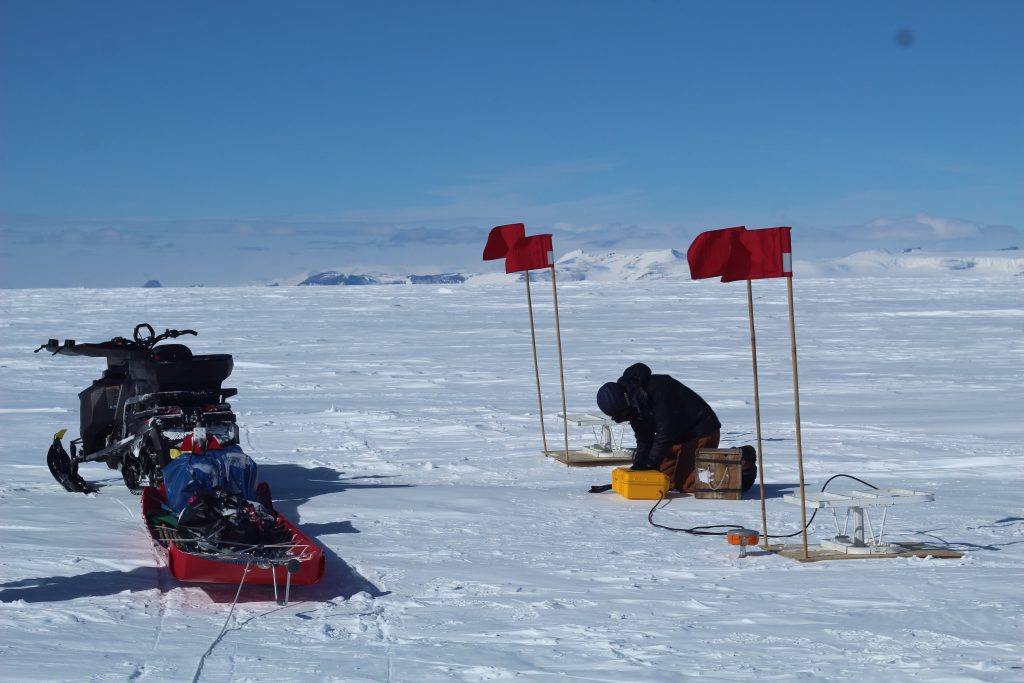
Field work at Taylor Dome, Antarctica
11/2025-
During 2025/26 Antarctic field season, I went to Taylor Dome, Antarctica to study firn: partially compacted snow that has survived a melt season and is on its way to becoming fully compacted glacial ice. This work is part of an NSF-funded project to resolve uncertainty surrounding firn compaction and supply observational data to numerical firn compaction models. Current firn models use steady-state firn compaction rates measured from firn cores. However, these models perform poorly in scenarios outside of the firn core calibration range since they rely on an assumption (the Clausius-Clapeyron relation) that is not unique everywhere or during all timescales. The goal of this project is to supply firn compaction models with physical data: in-situ measurements of firn compaction and grain-scale microstructures, via a constitutive relation and quantification of the processes that drive evolution of microstructure.
Taylor Dome is an ideal area because there is a fairly consistent annual temperature across the dome, despite wildly different annual accumulation rates (2-25 cm/yr across our four field sites). Since temperatures are fairly consistent, we can determine the reasoning behind the large changes in accumulation rate across the dome. TLDR: the main project goal is to collect real-world data about how much the snow squishes at Taylor Dome over the course of three years to give this information to numerical models so ice sheet modelers can better estimate how much ice is being gained and lost in Antarctica.
My team kept a field log documenting our work at Taylor Dome here. I also wrote a daily blog about this experience, which you can read here: