Welcome to the start of my series of posts about my first Antarctic field season! I’ll be posting every week with some updates about what my team and I have been up to on the day-to-day.
I’m a second-year PhD student at the University of Washington who uses remote sensing and machine learning to study outlet glaciers in northeast Greenland. So, what am I doing in Antarctica?
Background
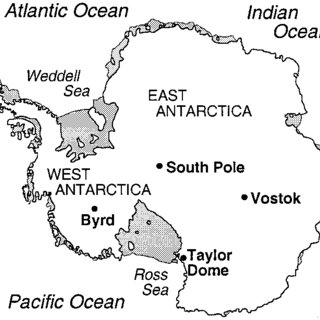
I’m going to Taylor Dome, Antarctica, to study firn: partially compacted snow that has survived a melt season and is on its way to becoming fully compacted glacial ice. This work is part of an NSF-funded project to resolve uncertainty surrounding firn compaction and supply observational data to numerical firn compaction models. Current firn models use steady-state firn compaction rates measured from firn cores. However, these models perform poorly in scenarios outside of the firn core calibration range since they rely on an assumption (the Clausius-Clapeyron relation) that is not unique everywhere or during all timescales. The goal of this project is to supply firn compaction models with physical data: in-situ measurements of firn compaction and grain-scale microstructures, via a constitutive relation and quantification of the processes that drive evolution of microstructure.
Taylor Dome is an ideal area because there is a fairly consistent annual temperature across the dome, despite wildly different annual accumulation rates (2-25 cm/yr across our four field sites). Since temperatures are fairly consistent, we can determine the reasoning behind the large changes in accumulation rate across the dome. TLDR: the main project goal is to collect real-world data about how much the snow squishes at Taylor Dome over the course of three years to give this information to numerical models so ice sheet modelers can better estimate how much ice is being gained and lost in Antarctica.
This season is the first of three: we’ll set up measurement stations at four different accumulation sites where we can continue to autonomously collect measurements over the winter, with a smaller team coming back during the 2026-27 and 2027-28 summer seasons to briefly check on the equipment at each site. We will collect three full years of data in total. That means that this season will be the most work – between drilling hundreds of meters of firn cores, collecting tens of kilometers of ice-penetrating radar data, and setting up each field site with strain gauges and in-situ ice-penetrating radar to measure firn compaction and thermistors to measure temperature. We will ship at least one firn core collected at each site back to the U.S. for further chemistry and gas measurements. (This is a quite simple description of the science, just so you get an idea of what we’re working on. More information to come soon!)
I’ll be in the field with a team of seven people: two Ice Drilling Program ice drillers (Elliot, engineer, eighth field season across Greenland and Antarctica and Forest, contract driller, fourth field season), two people who will deploy potentiometers to measure firn compaction and take temperature measurements down the boreholes (Ilyse, postdoc, first-timer and Dylen, PhD student, first-timer), two people (Ellen, PhD student, second field season and Claire, PhD student, first-timer) who will work on ice-penetrating radar, and one principal investigator (PI), Zoe, who is a jack-of-all-trades who has spent 40+ seasons in the field in Antarctica and New Zealand. We may also have a few team members supporting our field operations, including crevasse detection and field safety. We’re supported by two other PIs in the U.S., Kait, Ed, and Knut, who are not likely to deploy this season.
How do we get to Antarctica?
All team members traveled from different places in the United States to get to Antarctica. Zoe left in October to support a different field team before the rest of the Taylor Dome team arrives in November. I traveled from Seattle to San Francisco to Auckland to Christchurch – a total of 31 hours traveling and 16.5 hours total on a plane. Next, we’ll depart from Christchurch on a C-130, headed to McMurdo Station, Antarctica, for another 5-8 hour flight. Weather delays commonly affect these flights as the military personnel operating them are particularly cautious and only land if the weather is near-perfect. Turning around in the middle of a flight is not uncommon, it’s called “boomeranging” and is reserved for weather that changes while the plane is on the way. Fingers crossed that this doesn’t happen to us!
Science Prep
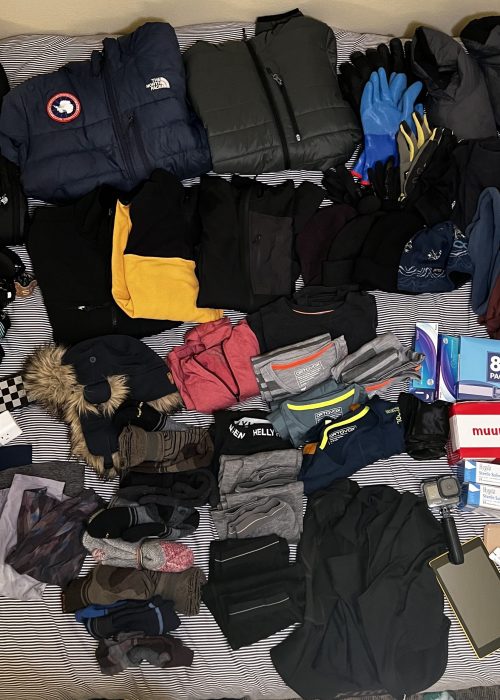
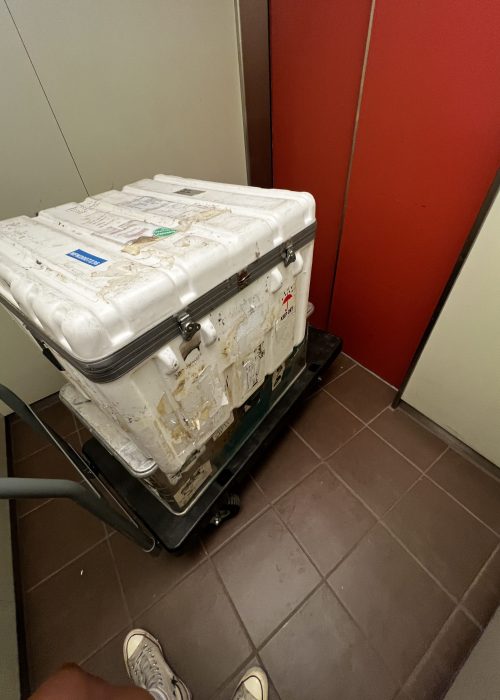
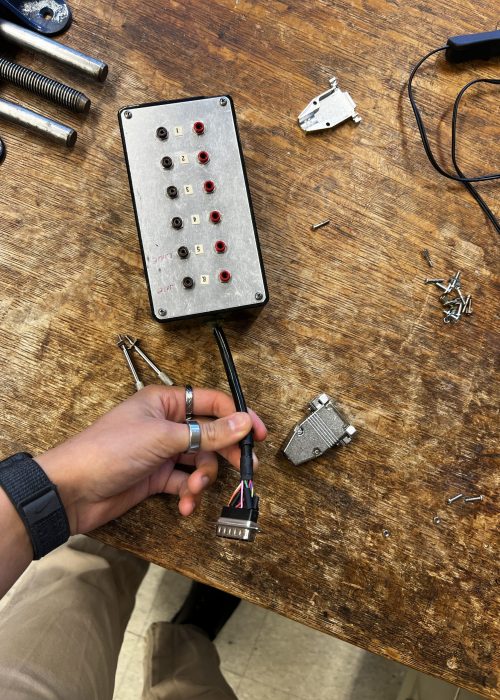
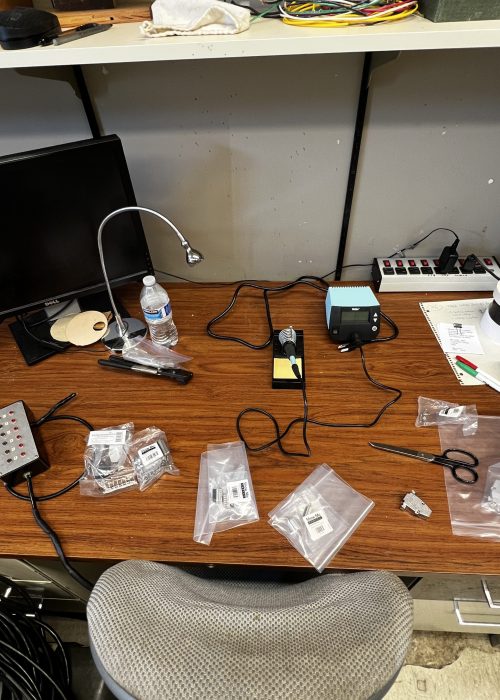
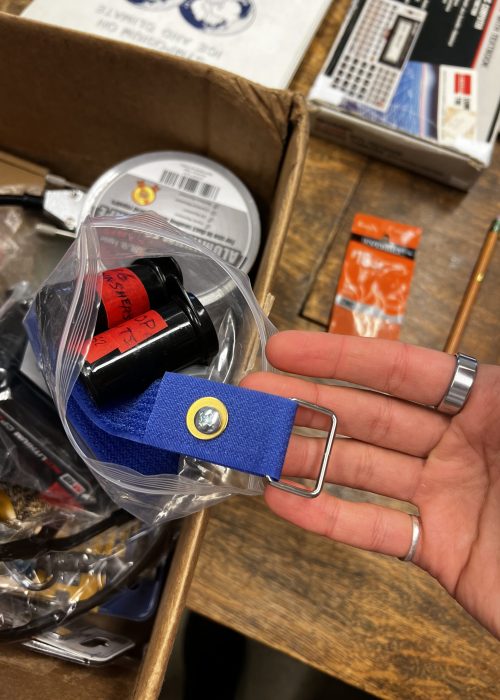
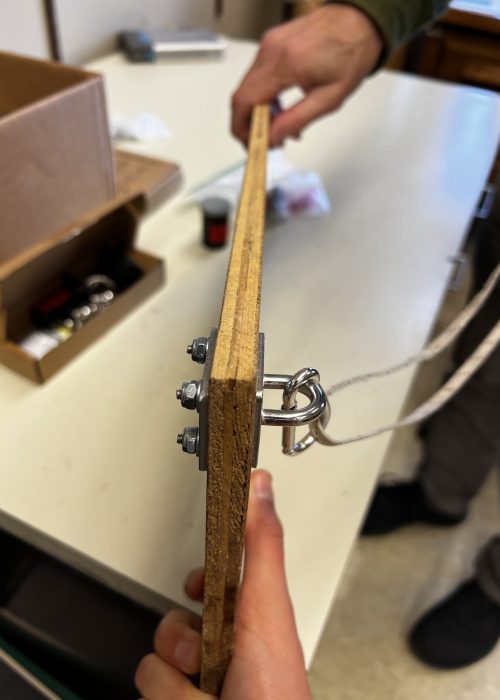
There is a lot that needs to be done to prepare for an Antarctic field season and most of this preparation happens before leaving the United States. Prior to joining this field team, Ellen and I were placed on a different field team that was cancelled due to federal funding cuts. As a result, we joined the Taylor Dome team quite late and have been scrambling to get up to speed. Dylen, Ilyse, and Zoe, however, have been waiting for three years to go! They have done the bulk of the work constructing strain gauges, wiring things, packing boxes, and soldering equipment. They packed and sent the majority of the equipment before I joined the team, so after they left UW to go back to their home institutions, I was tasked with testing, prepping, and hauling the rest of the science equipment and cargo. Here are a few of the tasks I did to prepare:
Disclaimer
The opinions expressed are solely my own and do not express the views or opinions of the National Science Foundation, the United States Antarctic Program, or the University of Washington. This blog is for entertainment purposes only.
❤️