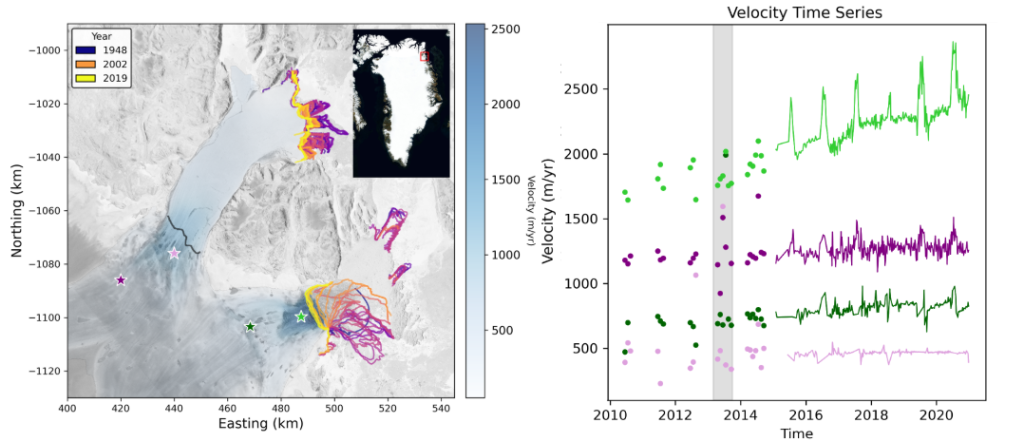
I am currently working with Dr. Michalea King and Dr. Ian Joughin at the Applied Physics Lab at the University of Washington. My work focuses on using machine learning to understand seasonal fluctuations of Greenland outlet glaciers. This is a work in progress but you can read the abstract here:
This study analyzes seasonal ice flow at two large outlet glaciers within the Northeast Greenland Ice Stream (NEGIS): Zachariæ Isstrøm (ZI) and Nioghalvfjerdsfjorden (79N). Though recent work has documented ongoing glacier thinning and mass loss at both sites, observations show more dramatic change at ZI, including the collapse of its floating ice tongue in 2013 and seasonal variability in ice flow that is now one of the greatest in amplitude across Greenland outlet glaciers, averaging ~5-10 gigatons of ice loss every summer. This work conducts a thorough investigation of seasonality at ZI, compared with neighboring 79N, and quantifies changes in seasonal ice flow and glacier geometry over the 2000-2025 period.
Previous work points to sub-annually varying climatic and glacial processes likely contributing to the observed seasonality. This includes the summertime production and discharge of meltwater, which can impact glacier sliding speeds as it drains through the subglacial hydrologic system by modulating the effective pressure at the ice bed. More recently, both modeling and observation-based studies conducted for a small number of outlet glaciers have also linked the formation, buildup, and subsequent breakup of proglacial mélange (the mixture of calved icebergs and sea ice that can form in glacier-fed fjords) to the timing of glacier advance and retreat. Still, the relative impact of these processes on glacier flow, how their impact is spatially distributed, and the potential for ongoing geometric changes to enhance or dampen a glacier’s sensitivity to each variable, remains critically unclear, posing a challenge to longer-term mass loss projections.
Here, we leverage interpretable machine learning to identify spatial and temporal patterns of seasonal change in mélange, meltwater, and ice velocity. We construct observational time series of glacier dynamic, geometric, and climatic variables as inputs to a machine learning model. Using a game-theoretic approach to quantitatively interpret machine learning models, we can expose a model’s reasoning behind its predictions across time and space, thereby improving understanding of how outlet glacier dynamical, geometric, and climatic variables affect seasonal velocity fluctuations and long-term ice mass loss.
I have presented this work at:
- 2024 UW ESS Research Gala
- 2025 West Antarctic Ice Sheet (WAIS) Workshop
- 2025 UW ESS Research Gala
This work has been featured in the media here: